Behind Every Great Museum Is a Great Storage System (And Probably a Few Dinosaurs)

Reading Time: 3 minutes
Museum Storage Solutions That Protect the Past, Organize the Present, and Make Room for the Future
Walk into a museum, and you're surrounded by history, art, science, and incredible discoveries.
A dinosaur that hasn't moved in 65 million years. A priceless painting that has survived centuries. Military uniforms that tell stories of courage. Ancient pottery that somehow survived thousands of years but might not survive one poorly organized storage room.
Now imagine what visitors don't see.
Behind the exhibits, museums are managing thousands—sometimes millions—of objects that need to be stored, protected, organized, and accessible.
And unlike your garage, museums can't just shove everything into a corner and promise to organize it next weekend.
That's where Spacesaver Storage Solutions comes in.
From high-density mobile shelving and museum collection cabinets to specialized art racks and archival storage systems, we help museums throughout Virginia make better use of their available space while supporting the long-term care of their collections.
Because history deserves better than a dusty shelf.
1. Museum Storage: Where the Real History Lives
Here's a little museum secret: Some of the most fascinating objects in a collection aren't even on display.
Museums frequently rotate exhibits, preserve fragile artifacts, accommodate traveling collections, and maintain extensive research archives.
That means the storage areas behind the scenes can be just as important as the galleries themselves.
Museum storage must accommodate an extraordinary variety of objects, including:
- Historical documents, photographs, and archival records
- Paintings, framed artwork, and sculptures
- Fossils, minerals, and geological specimens
- Military uniforms, equipment, and historical artifacts
- Botanical collections and natural history specimens
- Archaeological discoveries and cultural objects
- Oversized artifacts and unusual collections
And here's the challenge: Not everything belongs on the same shelf.
A 200-year-old painting needs different storage than a fossilized dinosaur bone. A military uniform shouldn't be stored like a box of office supplies. And a delicate botanical specimen definitely doesn't belong underneath a cannonball.
The solution? Storage designed around the collection—not the other way around.
2. High-Density Mobile Shelving: Making History Fit Without Building an Addition
More collection space. Same building. Less wasted aisle space.
Museums have a common problem: Their collections keep growing, but their buildings don't.
Traditional shelving requires permanent aisles between every row. Those aisles take up valuable square footage that could otherwise be used for collections.
Spacesaver High-Density Mobile Storage Systems eliminate many of those fixed aisles by mounting shelving or cabinets on mobile carriages.
Instead of maintaining multiple aisles, the system opens an aisle where access is needed.
Why Museums Love High-Density Mobile Storage
- Increase storage capacity within existing floor space
- Organize collections by department, classification, or object type
- Improve access to stored materials
- Support collection expansion without immediately requiring additional space
- Accommodate specialized shelving, cabinets, and collection accessories
- Make better use of valuable climate-controlled storage areas
Ideal Applications: Museum archives, historical collections, research materials, boxed artifacts, and collections requiring organized, space-efficient storage.
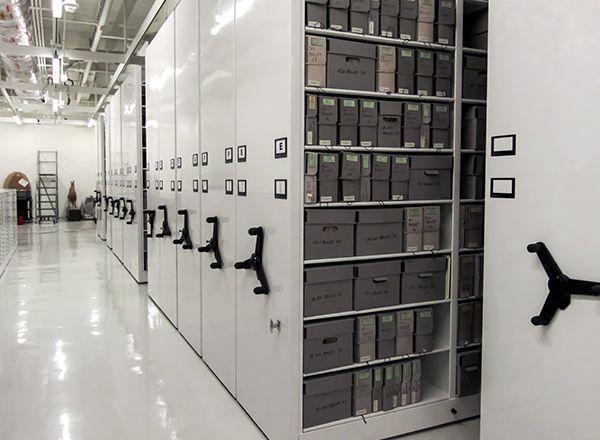
The Spacesaver Advantage: When your museum is running out of room, the answer isn't always a bigger building. Sometimes it's a smarter storage system.
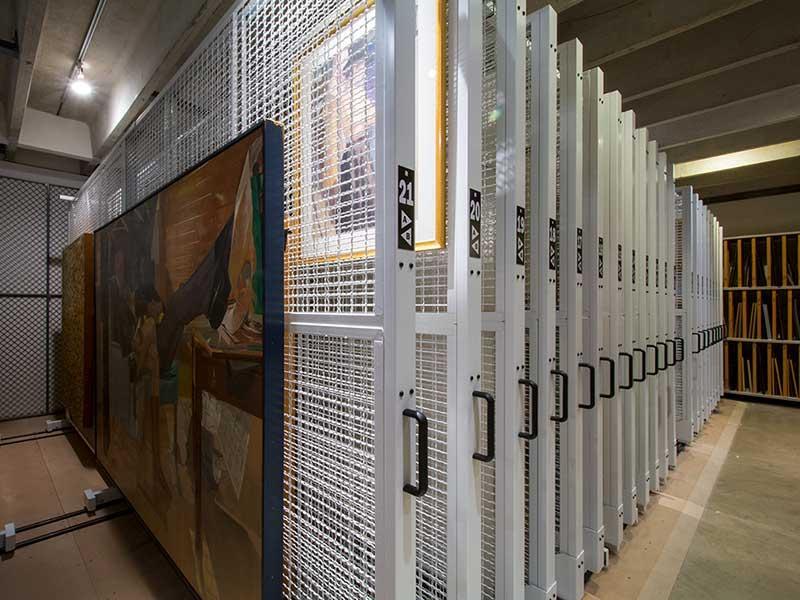
3. Museum Art Racks: Because Paintings Shouldn't Play Dominoes
Imagine carefully preserving a painting for 150 years, only to have it damaged because someone leaned it against another painting in storage.
Not exactly the kind of history anyone wants to make.
Spacesaver Art Rack Storage Systems provide organized solutions for storing framed artwork and other suitable hanging collections.
Depending on the collection and facility, options may include:
- Mobile Art Racks: Sliding panels that provide access to stored artwork while using floor space efficiently.
- Wall-Mounted Art Racks: A practical option for collections with limited floor space.
- Floor-Supported Art Racks: Flexible storage configurations for collection rooms and galleries.
- Art Lateral Racks: Organized hanging storage for paintings and framed objects.
- Carriage-Mounted Art Racks: High-density configurations designed to accommodate larger collections.
These systems help museum staff access individual works while reducing unnecessary handling and overcrowding.
Ideal Applications: Fine art museums, university galleries, historical societies, and cultural institutions.
Because priceless art deserves more than a place against the wall.
4. Museum Storage Cabinets: Small Artifacts, Big Responsibilities
Not every museum treasure is enormous.
Some of the most important objects are small, delicate, and surprisingly easy to misplace.
Think coins, medals, textiles, archaeological fragments, documents, scientific specimens, and historical collectibles.
That's where specialized museum storage cabinets and archival drawer systems come into play.
Spacesaver offers storage configurations that may include:
- Preservation cabinets
- Archival flat file cabinets
- Oversized storage cabinets
- Modular drawer cabinets
- Specialized collection storage cabinets
Properly selected cabinets can help protect objects from unnecessary handling, physical damage, and disorganization.
Flat Files: Keeping History on the Level
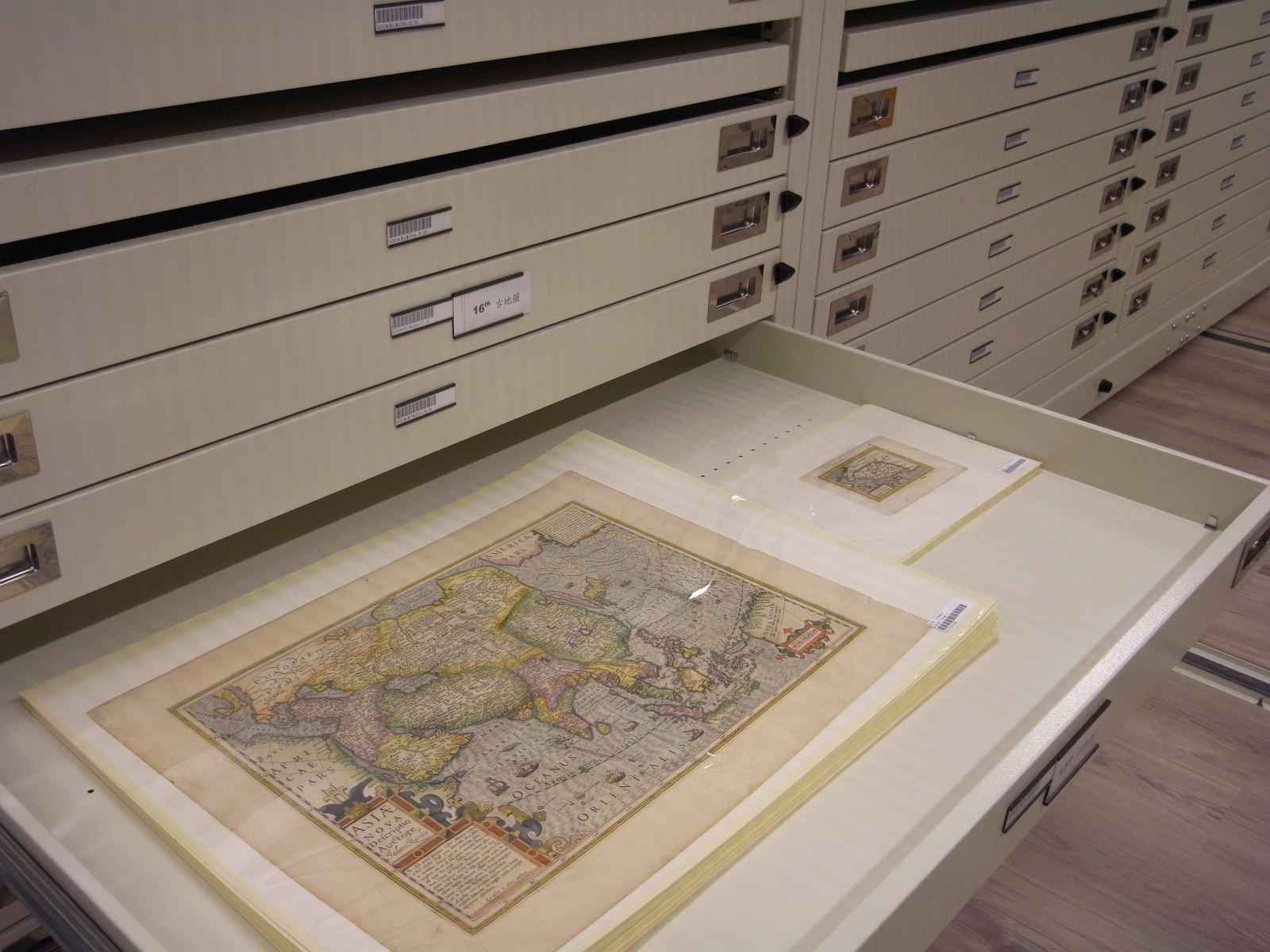
Large documents, maps, photographs, architectural drawings, and other flat materials often require horizontal storage.
Archival flat file cabinets provide organized drawer storage that helps reduce unnecessary folding, rolling, or stacking.
Ideal Applications: Historical maps, oversized documents, prints, posters, and archival collections.
After all, a 19th-century map shouldn't have to survive the 21st-century equivalent of being stuffed into a junk drawer.
5. Natural History Museums: Storage for Everything From Butterflies to Brontosauruses
Natural history museums have one of the most unusual storage challenges imaginable.
One room might contain tiny insects. Another holds geological specimens. Down the hall? Fossils, animal specimens, botanical collections, and objects that haven't seen daylight in millions of years.
Try finding a one-size-fits-all shelving system for that.
Spacesaver Natural History Museum Storage Solutions can be configured for different collection types, including:
Botany Cabinets: Specialized cabinets for organizing herbarium sheets and botanical specimens.
High-Density Mobile Shelving: Space-efficient storage for boxed specimens, reference collections, and research materials.
Modular Drawer Cabinets: Organized storage for smaller geological, archaeological, and scientific specimens.
Heavy-Duty Shelving: Storage for appropriately supported, heavier collections and equipment.
Oversized Cabinets: Solutions for objects that don't fit standard cabinet dimensions.
For museums managing scientific collections, storage should support preservation requirements, collection tracking, and researcher access.
Because when a researcher asks for a particular fossil, the answer shouldn't be, "We think it's somewhere behind the mammoth."
6. Military and History Museums: Preserving the Stories Behind the Artifacts
Military and historical museums preserve objects that represent significant moments in our nation's history.
Their collections can include uniforms, medals, documents, tools, equipment, historical weapons, and oversized artifacts.
And while these objects may share a historical theme, their storage requirements can be dramatically different.
Spacesaver can help museums organize their collections with:
- Heavy-duty shelving for appropriately supported equipment
- Modular drawer cabinets for smaller artifacts
- High-density mobile storage for archival collections
- Specialized cabinets for sensitive historical materials
- Storage racks for larger or unusually shaped objects
- Secure storage configurations where access control is required
A Virginia Connection: Preserving Military History
Virginia has a remarkable military heritage, and its museums and historical institutions play an important role in preserving that history.
Spacesaver storage solutions have been used at the U.S. Army Ordnance Training Support Facility at Fort Lee, Virginia, now Fort Gregg-Adams, where specialized storage configurations helped organize military historical collections.
From drawer storage to heavy-duty racking and flat files, the right combination of systems can accommodate an impressive variety of artifacts.
The goal isn't simply to store history. It's to make that history accessible for future generations.
7. Climate-Controlled Museum Storage: Every Square Foot Matters
Museums often invest heavily in controlled environments to support collection preservation.
Maintaining appropriate temperature, relative humidity, lighting, and environmental conditions can be expensive.
So why waste valuable conditioned space on unnecessary aisles?
High-density storage can make better use of these specialized environments by increasing the amount of collection storage within an existing footprint.
The result can be a more efficient use of museum facilities and infrastructure.
Of course, storage systems must be selected with collection conservation requirements in mind, including airflow, access, loading, environmental monitoring, and fire protection.
Smart museum storage complements proper conservation practices—it doesn't replace them.
8. Growing Collections, Shrinking Space: The Museum Storage Dilemma
Museums are constantly collecting, researching, cataloging, and preserving new objects.
But storage space doesn't magically appear every time someone donates a collection.
Eventually, the questions become familiar:
"Where are we going to put this?"
"Can we fit another cabinet?"
"Does anyone know what's in those boxes?"
And everyone's favorite:
"Are we seriously considering another building?"
Before investing in a costly expansion, consider whether your existing storage areas are being used efficiently.
Spacesaver Storage Solutions can help evaluate:
- Existing collection storage layouts
- Available floor space and vertical storage opportunities
- Collection sizes, weights, and handling requirements
- High-density mobile storage opportunities
- Specialized cabinets, drawers, and art rack configurations
- Future collection growth and expansion needs
A well-planned storage system can improve organization today while providing flexibility for tomorrow.
9. Museum Storage Solutions for Virginia's Cultural Institutions
From Richmond's historic museums to the cultural institutions of Hampton Roads, Virginia is home to extraordinary collections.
Spacesaver Storage Solutions works with museums, universities, archives, historical societies, and cultural organizations throughout Central and Coastal Virginia, including:
Richmond, Henrico, Chesterfield, Fredericksburg, Ashland, Glen Allen, Virginia Beach, Norfolk, Chesapeake, Newport News, Hampton, and surrounding communities.
Our team can assist with storage planning, system selection, installation, and ongoing service.
Whether you're renovating an existing collection room, planning a new museum facility, or simply trying to reclaim space in an overcrowded archive, we can help develop a storage solution suited to your collections and facility.
10. The Best Museum Exhibits Start Behind the Scenes
Visitors come to museums to experience the extraordinary.
They marvel at ancient civilizations, admire beautiful artwork, explore scientific discoveries, and connect with history.
But behind every successful exhibition is an enormous amount of work involving curators, conservators, registrars, collection managers, researchers, and museum staff.
And supporting all that work is something visitors rarely notice.
The storage.
Well-designed museum storage helps institutions protect collections, improve accessibility, support research, and make room for future acquisitions.
At Spacesaver Storage Solutions, we believe preserving history starts with giving it the space it deserves.
And if your museum happens to have a dinosaur skeleton, a priceless painting, and a collection of 18th-century uniforms?
We've got some ideas.
Let's Make Room for History
Your museum's collection is one of a kind. Your storage solution should be, too.
Spacesaver Storage Solutions provides customized museum storage systems, high-density mobile shelving, art racks, preservation cabinets, and archival storage solutions throughout Virginia.
Contact Spacesaver Storage Solutions today to discuss your museum's storage challenges and discover how we can help you protect the past while making room for the future.
Spacesaver Storage Solutions — Storage Solved.